Art Supplies Market Outlook 2027: Where Growth Is Coming From
Short answer: the art supplies market is growing, but not evenly, and the published size figures disagree so widely that the headline number is the least useful part of any forecast. What a buyer can actually act on in 2027 is the structure underneath it: which regions grow faster than the average, which product types carry recurring replacement demand, and which buyer group is moving up in specification. This guide sets out the published data, shows where the estimates conflict and why, and then converts each finding into a concrete purchasing action.
What the published numbers actually say
The most recent full market study available at the time of writing values the global art supplies market at US$16.90 billion in 2025, rising to US$24.05 billion by 2034 at a 4.00% CAGR across 2026–2034. That study, published in September 2026, covers paints, drawing paper and pads, pencils, pens, highlighters, brushes, erasers and colors, across home, commercial, education and independent-professional end users.
That is one number. It is not the only one.
Four credible estimates, four different answers
| Source and publication date | Base value | Forecast | CAGR |
|---|---|---|---|
| The Insight Partners (Sept 2026) | US$16.90bn (2025) | US$24.05bn (2034) | 4.00% |
| Allied Market Research | US$12.2bn (2023) | US$20.0bn (2035) | 4.2% |
| Business Research Insights | US$9.31bn (2026) | US$16.18bn (2035) | 6.5% |
| Dataintelo | Not disclosed in summary | Not disclosed in summary | 4.9% |
The base values for overlapping periods differ by nearly a factor of two, and the growth rates span roughly 4% to 6.5%. You will also find secondary articles quoting 8.8% or 13.1%, but those are not accompanied by a stated scope, so they cannot be compared with the rest.
Why they disagree — and what that means for a buyer
The gap is almost never about the market growing at different speeds. It is about what each analyst put inside the boundary:
- Scope of "art supplies." Some studies include general stationery, office writing instruments and school supplies lists; others cover only fine-art and creative materials. A wide boundary raises the base value and usually lowers the percentage growth.
- Channel treatment. Whether school distributors and institutional tenders are counted as a separate channel or folded into retail changes the regional split substantially.
- Base year. Comparing a 2023 base with a 2026 base across a period that included both a freight-cost spike and a normalization makes the CAGR gap look like a demand difference when it is largely a timing artifact.
The purchasing consequence: do not build a volume commitment on a single headline CAGR. Use the directional findings, which the studies broadly agree on, and set your own unit targets from your own sell-through. A forecast tells you where to point inventory. It does not tell you how much to buy. Your own replenishment data does that.
Where the growth sits — by region
The regional pattern is the most consistent part of the published data, and the most directly usable for a sourcing plan.
| Region | Share of global market, 2025 | Forecast CAGR, 2026–2034 |
|---|---|---|
| North America | 31–34% | 3.6–4.1% |
| Europe | 26–29% | 3.2–3.8% |
| Asia Pacific | 25–28% | 4.6–5.3% |
| Middle East & Africa | Not given as a share | 3.9–4.5% |
Within North America, the United States accounts for 78–82% of the regional market. Europe's demand is concentrated in Germany, the UK, France, Italy and Spain. Asia Pacific is led by China by consumption scale, with Japan and South Korea carrying the premium writing and illustration categories.
Reading the region table as a purchasing decision
Asia Pacific is the fastest-growing region on paper, but its growth is the least margin-rich for an exporter, because a large share of the incremental demand is price-sensitive student product bought through organized retail that negotiates hard. Europe is the slowest-growing region and also the most specification-demanding: certified wood, low-toxicity raw materials, recyclable packaging and durable construction are effectively entry requirements rather than differentiators.
The practical reading is that volume growth is in Asia Pacific while margin growth is in North America and Europe, and those two require different inventory. A single universal assortment priced for the middle serves neither. This is the case for splitting your range into a value pack architecture for price-led channels and a step-up architecture for specification-led channels, rather than carrying one line and discounting it in the markets that push back.
Where the growth sits — by product
Segment-level data is thinner than regional data, but two findings are robust across sources.
Colored pencils: the clearest premium path
The colored pencils segment was valued at US$2.14 billion in 2024 and is forecast to reach US$4.35 billion by 2034, a 6.8% CAGR — comfortably above the 4.00% overall market rate. Segment reporting splits it by end user (painter, amateur, architect), by channel (offline, online) and by type: water-soluble versus dry.
That type split is the commercially important line in the whole forecast. The professional and architect end of the segment does not buy the same pencil as the classroom end, and the difference is not just color count — it is core hardness, lightfastness and whether the core responds to water. A supplier that can hold a water-soluble core and a dry core to the same color standard across repeat orders is selling something different from a supplier shipping one generic set at several color counts.

Paints, brushes and paper: the replacement engine
The product-type grouping that covers paints, paper, pencils, pens, brushes, erasers and colors represents roughly 61–65% of the market and is expected to grow at 3.8–4.3%. Its defining characteristic is recurring replacement. Paper pads are consumed and reordered; paints and markers are used up; brushes wear out; erasers disappear. That makes this group dependable rather than glamorous, and it is where a distributor's reorder rate is decided.
One caution on the trend instead of the number: the studies that show the highest growth rates in brushes and paper are often counting premiumization rather than unit growth. Synthetic bristle systems, ergonomic handles and durable ferrules improve the product, and also raise the unit price without raising the unit count. If you forecast on value growth and plan production on unit growth, you will under-order.
Independent professionals: small share, fastest growth
Independent professionals hold only 10–13% of the market but are forecast to grow at 5.0–5.7%, the fastest of any end-user group. This is creator monetization showing up in the data. These buyers purchase in small quantities, but they buy repeatably, they specify aggressively, and they are unusually willing to pay for lightfast pigments, archival paper and consistent nib performance.
For an OEM supplier this group is best served not by a new product but by a step-up series that lets a school-range buyer move into studio specification without changing supplier. The published data describes the demand; the step-up range is the mechanism that captures it.
The specification shifts behind the numbers
Three changes in what buyers ask for cut across every region and segment. None of them are new, and all three are accelerating.
Safety and material documentation as a gate, not a feature
Regulatory frameworks around safe chemicals, sustainable forestry and recyclable packaging are tightening, and they change what can be listed rather than what sells best. A product that cannot produce current documentation does not compete on price; it does not get onto the shelf. EN 71 for the European market, ASTM D-4236 for the United States, CE marking where the framework applies, and BSCI or equivalent social-audit documentation for larger retail accounts are the minimum paper a serious buyer now requests before a first order.
Sustainability moving from claim to specification
Recycled paper stock, wood-certified pencils, water-based ink systems and refillable constructions have moved from marketing language into purchase specifications. The reason is commercial: a retailer that has committed to a packaging or sourcing target cannot meet it by switching one SKU, so the requirement propagates down to every supplier in the category.
Low-odor and water-based reformulation
Odor and solvent content affect where a product can be sold and to whom. Low-odor and water-based formulations open classroom, home and gift channels that solvent-based equivalents cannot serve, which is why the reformulation pressure is strongest exactly in the fastest-growing end-user segments.

What this means for your purchasing plan
This is the section that matters most, because a forecast has no value unless it changes an order. Each finding above maps to a specific procurement action.
| Published finding | What to do with it | When |
|---|---|---|
| Overall market grows at a moderate single-digit rate; estimates disagree by up to 2×. | Do not set a single volume commitment off the headline number. Set unit targets from your own reorder history and treat forecasts as directional. | Before the next buying cycle |
| Asia Pacific grows fastest (4.6–5.3%) on price-sensitive volume. | Build a value pack architecture sized for price-led channels rather than discounting your standard line. | Next cycle, low risk |
| Europe is slowest but most specification-driven. | Lock current EN 71 and material documentation before quoting, and price the compliance work into the unit cost rather than treating it as overhead. | Immediately, before quoting |
| Colored pencils grow at 6.8%, split by water-soluble vs dry. | Carry both core types in the same color standard instead of one line at several color counts. This is the highest-margin expansion available. | Next cycle, priority |
| Independent professionals grow fastest (5.0–5.7%) from a small base. | Add a step-up series that shares color standards with your school range, so existing accounts can trade up without re-sourcing. | Next two cycles |
| Paper, paints, brushes and erasers are the replacement engine. | Move these to a standing replenishment agreement rather than per-order quoting. Reorder rate, not first-order price, decides the account's value. | Immediately, for existing accounts |
| Sustainability and safety documentation are now entry gates. | Verify certificate currency per SKU before the selling season, not after a buyer asks. An expired document is a lost order discovered too late. | Immediately |
What to lock now, what to test, what to wait on
- Lock now: documentation currency for every SKU you already sell; replenishment terms on paper, paints and brushes; and a second core type in colored pencils, because the 6.8% segment rate is the clearest above-average signal in the data.
- Test now: a step-up series aimed at independent professionals. The share is small, so a test quantity is enough to learn whether your existing accounts trade up — and a failed test costs little.
- Wait on: new capacity or new tooling justified purely by a regional CAGR. The regional differences are real but modest, and capacity commitments are the least reversible decision on this list.
Material and process choices that decide the margin
Because the growth is concentrated in segments that specify rather than segments that merely reorder, the material decisions carry more weight in 2027 than they did in a volume-led market.
Core material in colored pencils
The three core chemistries behave differently in production and in use, and the choice constrains which end users you can serve.
| Core type | Behavior | Production implication | Best fit |
|---|---|---|---|
| Wax-based | Softest lay-down, blends easily, lower lightfastness | Easiest to extrude at speed; lowest breakage risk in transit | Classroom and children's ranges |
| Oil-based | Harder core, holds a point, richer layering, better lightfastness | Needs tighter core-to-barrel tolerance; breakage control is the main yield driver | Illustration, retail art sets, gift |
| Water-soluble | Dry like a pencil, then reacts to water like paint | Core formulation is the hardest of the three to hold consistent batch to batch | Mixed-media, student to professional |
The purchasing consequence: a supplier's ability to hold a water-soluble core to a consistent color standard is a capability question, not a price question. If you are adding water-soluble to a range that was previously wax-based, qualify the core first and price the color counts second.
Packaging: the fastest lever on shelf position
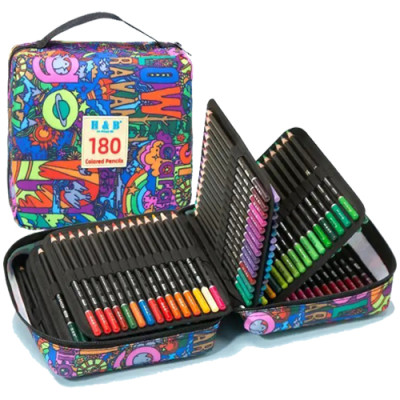
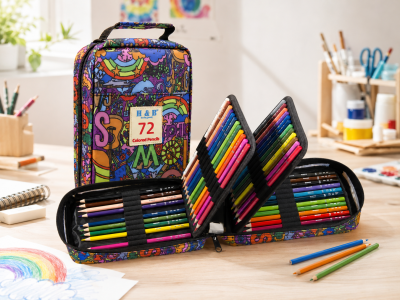
Tin box, PP box and fabric bag carry different unit costs, different damage profiles in transit, and different shelf signals. A tin reads as a gift or a step-up product and survives shipping with minimal internal protection; a PP box is the cheapest way to present a high color count; a fabric bag lowers unit cost and freight weight on large kits but offers almost no protection to the contents. Choose the packaging against the channel the SKU is destined for, not against the unit cost alone — a reworked or returned set costs more than the packaging differential that caused it.

A realistic planning position for 2027
Pulling the published data together, the defensible planning position is a market growing at a moderate single-digit rate, with above-average growth in colored pencils and a smaller premium segment, faster unit growth in Asia Pacific offset by weaker pricing there, and slower but higher-margin demand in Europe and North America where documentation and sustainability are now prerequisites rather than advantages.
Shanghai Haobin has manufactured art materials since 2010 and exports to more than 60 countries. The range covers wax, oil and water-soluble colored pencils, acrylic paints, brushes, markers, pastels and paper, with OEM, ODM and private-label capability and factory documentation covering EN 71, ASTM D-4236, CE and BSCI. Because the cores, barrels, packaging and kit assembly run through the same facility, an approved sample remains the production reference across repeat orders — which is what makes a step-up series practical rather than a re-sourcing project.
How to start
Send your SKU list with the target market, the target price band and the quantity. We will come back with the configuration, the minimum and the lead time for that specific item, and the current certificate list for the destination you are shipping to.
Supply programs by buyer type · Private label · Buyer questions