Art Supplies Packaging and Kit Assembly: What Buyers Should Specify
Packaging is part of an art supply product’s performance. It should protect pencils, paints or tools in transit, help the user find and store the contents, and carry accurate information for the destination market. Buyers can choose among tins, rigid boxes, folding cartons and fabric cases by testing the complete packed set—not by assuming one format is automatically more premium.
Choose Packaging for the User’s Routine
For a school set, students and teachers may open the pack repeatedly and need to return pieces to the right place. For a gift set, the first opening should show the contents clearly and protect them until use. For a travelling artist, portability and secure closure may matter more than a decorative lid. The correct format depends on the product and the user’s routine.
Ask a representative user to open the sample, remove an item, complete the intended task and put everything back. Note where a tray is too tight, a zipper catches, a hinge feels weak or color names are hard to read. This simple test can reveal more than a photo of the closed box.

Compare Tins, Cartons and Cases by Function
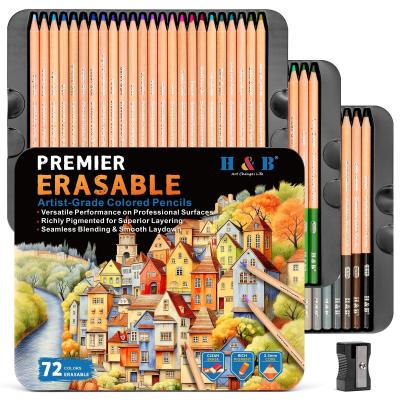
A tin can offer a durable shell and organized tray, but check lid fit, hinge strength, sharp edges and movement of contents. A folding carton can provide printable space and efficient shipping, but may need an inner tray to protect fragile pieces. A fabric case can be convenient for carrying tools, but test zipper durability, elastic retention and cleaning. A rigid box can present a set neatly, but its weight and dimensions affect freight and shelf space.
There is no universal cost premium or retail uplift for any format. Ask for a quote on the same product in each feasible package, including tooling, print quantity, assembly and outer-carton implications. Compare landed cost with the protection and usability observed in samples.
Protect the Contents Through Distribution
Inspect the packed set and its shipping carton together. Check whether pencil cores can move or fracture, paint containers can leak, brushes can deform and small accessories can escape their slots. Define the transport and handling conditions relevant to the route. Agree how many units will be inspected and what counts as an unacceptable packaging defect.
Ask the supplier for carton dimensions, unit weight, case pack, stacking instructions and the packing sequence. If an insert or tray changes, retest the protection and the user’s ability to remove the item. A design that looks attractive in a sample can fail when the full carton is packed.

Reserve Space for Accurate Labels
Before final artwork, identify destination markets and the finished product’s classification. Set aside space for required identification, warnings, age information, languages, barcode and responsible-party details as applicable. For U.S. art materials, the CPSC explains ASTM D4236 labeling and the conformity statement. For EU toys, the European Commission describes toy safety and CE marking. The exact requirements depend on the item.
Do not place “non-toxic,” “fully certified,” sustainability or lightfastness claims on packaging until the evidence is tied to that SKU and its components. A label proof should be checked against current reports and the product specification, then signed off before printing.
Control Artwork and Component Changes
Give each dieline, proof and specification a revision number. Confirm who owns the artwork, who signs the print proof and how the final approved file reaches the printer. Request a production sample with the actual product inside the actual pack. If the supplier changes a tray, board grade, tin coating, case fabric or printed claim, require notice before production.
For repeat orders, compare the new pack against the signed reference, not an early mock-up. Record color consistency, text accuracy, barcode scan, closure and retention. If a sustainable material claim is made, request the relevant material or chain-of-custody evidence for the component named in the claim.

Put These Details in the RFQ
- What is the exact product and accessory list inside the package?
- How are pieces retained, separated and protected?
- What are unit and outer-carton sizes, weights and case packs?
- What artwork, languages, barcode and warning space are required?
- What samples, inspection tests and defect definitions will be used?
- Which changes to materials, print or components require approval?
- What are the quoted tooling, print, assembly and reorder terms?
A buyer can then choose packaging that protects the item, helps the user and can be repeated reliably. The decision should be based on the approved pack, user test and current quotation.