Brush Pens vs Alcohol vs Water-Based Markers Explained
Short answer: the three families are separated by their carrier solvent, not by brand or price. Brush pens carry water-based dye through a flexible fiber nib, so they give line variation and are safe for school use. Alcohol markers carry dye in ethanol or isopropanol, dry in seconds and blend into smooth gradients, but the ink is flammable and not intended for children. Water-based paint markers carry pigment rather than dye in an acrylic or water carrier, so they sit on top of the surface instead of soaking in and work on paper, wood, glass and ceramic. Pick the ink base first, then the color count, then the nib — choosing in any other order is how brands end up with a set that sells badly.
What actually separates the three families
Markers that look identical on a shelf behave completely differently once the cap comes off, because the solvent inside decides drying speed, blending behavior, surface compatibility and even the plastic the barrel can be molded from. Buyers who compare only color counts and unit price are comparing the one dimension that does not drive repeat orders.
Water-based markers and brush pens
A water-based marker uses deionized water as the main solvent, combined with dye or pigment at roughly 5 to 10 percent, humectants such as glycerin or glycol to slow evaporation, surfactants to keep ink flowing through the nib, and preservatives to stop microbial growth inside the reservoir(1). The result is an odorless, low-viscosity ink that is the standard choice for schools, children's art and general office use.
A brush pen is best understood as a water-based marker with a fiber nib shaped like a brush. That nib is what creates the pressure-sensitive stroke width that makes brush pens the default tool for lettering, linework and illustration outlines. The trade-off is built into the chemistry: because the ink stays water-soluble, it is not waterproof and can reactivate if the finished work gets wet.
Alcohol markers
Alcohol markers replace water with ethanol, isopropanol or n-propanol, and carry a higher dye load, typically 8 to 15 percent, together with resins and binders that improve adhesion to non-porous surfaces(1). Because the solvent evaporates in roughly 2 to 5 seconds instead of 10 to 20, color can be laid down and blended while the previous pass is still open — which is the entire reason alcohol markers produce the smooth, almost airbrushed gradients associated with illustration, character art and product rendering(2).
The same fast evaporation creates the two constraints buyers most often underestimate. Alcohol ink penetrates thin paper and bleeds through, so a marker pad or bleedproof paper is part of the product, not an accessory. And the ink is flammable with a noticeable solvent odor, which keeps it out of children's products and changes how it can be stored and shipped.
Water-based paint markers
The third family — what most buyers mean by paint pens, and what the acrylic range in this category covers — carries pigment in an acrylic or water-based carrier rather than dye in solvent. Pigment particles sit on the surface instead of soaking in, so coverage is opaque and the color does not depend on what is underneath. That is why this family is the one that works on canvas, rock, ceramic, fabric and wood as well as paper, and why it is the family that shows up most often in craft, DIY and mixed-media listings.
Brush pens vs alcohol markers vs water-based markers: side by side
The table below compares the three families on the properties that decide which one a given market will accept. The parameters are drawn from published ink-system comparisons rather than from a single brand's specification sheet.
| Property | Water-based / brush pens | Alcohol markers | Water-based paint markers |
|---|---|---|---|
| Carrier solvent | Water | Ethanol / isopropanol / n-propanol | Water or acrylic dispersion |
| Colorant | Dye or pigment, 5–10% | Dye, 8–15% | Pigment particles |
| Drying time | Moderate, about 10–20 seconds | Fast, about 2–5 seconds | Moderate, film-forming |
| Odor | Essentially odorless | Noticeable solvent odor | Low odor |
| Bleed-through on thin paper | Minimal | High — dedicated marker paper needed | Low on paper, sits on surface |
| Surface compatibility | Paper, card, cardboard | Paper, glass, plastic, metal | Canvas, rock, ceramic, fabric, wood, paper |
| Opacity | Translucent | Translucent, builds in layers | Opaque |
| Blendability | Limited | Excellent | Limited, but layering is forgiving |
| Lightfastness | Fair | Excellent | Good to excellent |
| Child safety | Non-toxic, EN 71 route | Flammable — not for children | Non-toxic grades available |
| Typical shelf life | 12–18 months, humidity dependent | 18–24 months | 18–24 months, seal dependent |
| Factory unit cost | Lower | Higher (solvent plus higher dye load) | Mid, pigment dependent |
Parameter sources: published ink-system comparison for stationery brands(1); retail application guidance(2). Unit cost direction reflects raw-material structure, not a quotation.
How the ink base decides the hardware
Solvent choice is not just a formulation question — it changes which components can be used at all, and therefore what a factory has to tool for. Three consequences matter for sourcing:
- Barrel resin. Water-based ink is compatible with PP (polypropylene) barrels. Alcohol-based ink generally needs PE or ABS with better solvent resistance. A brand that switches a proven set from water-based to alcohol ink without re-checking the barrel is specifying a product that will stress-crack or fog.
- Nib fiber. Water-based markers typically use fiber or bullet tips that meter ink flow; alcohol markers need porous chisel or brush tips built from solvent-resistant fibers such as polyester or nylon. The two tip types are not interchangeable across ink systems.
- Cap seal. Because alcohol evaporates faster, alcohol markers need air-tight caps with low air permeability. A cap that performs acceptably on a water-based pen can dry out an alcohol marker on the shelf, which is the most common source of "dead pen" returns.
The practical consequence for a buyer is that "same set, different ink" is not a one-line change order. It moves the barrel, the nib and the cap, and it usually moves the MOQ and the sampling timeline with them. Testing at the factory is built around that reality: viscosity and flow-rate measurement, color density inspection against a ΔE tolerance, and evaporation plus leakage resistance tests(1).
Why the published market numbers disagree
Anyone building a marker line will eventually look for a market size figure, and will find several that contradict each other. That is not a research failure — it is a definition problem, and it is worth understanding before a single number gets written into a business case.
| Source | What it measured | Value |
|---|---|---|
| Research and Markets | Alcohol-based marker market | USD 2.01 bn (2025) → 2.15 bn (2026) |
| The Insight Partners | Alcohol-based markers market | USD 2.86 bn (2025) → 4.10 bn (2034) |
| Future Market Insights | Art and office marker pen market | USD 2.4 bn (2025) → 4.6 bn (2035), 6.6% CAGR |
| Transparency Market Research | Global marker pen market | USD 2,444.0 m (2025) → 3,689.5 m (2036), 3.8% CAGR |
| Persistence Market Research | Marker pens market | USD 368.2 m (2025) → 587.3 m (2032), 6.9% CAGR |
| GM Insights | Alcohol-based share of art and office marker revenue | 31.5% (2025) → 32.4% (2035), ~7% CAGR |
The same category appears to be worth anywhere from roughly USD 0.37 bn to USD 2.86 bn in the same year, depending on whether the report is counting marker pens as a whole, the art-and-office subset, or alcohol-based markers specifically. Two conclusions follow that are actually usable: growth in the segment is real and consistently reported in the mid-single-digit to high-single-digit range, and no single headline number should be used as the basis for a purchase commitment. Use the direction, and verify demand against your own channel instead.
Choosing a specification: a sequence that works
Because the ink base constrains everything downstream, specification decisions have a natural order. Running them out of order is the main reason first orders have to be re-tooled.
| Step | Decision | Rule to apply |
|---|---|---|
| 1 | Ink base | Children, schools or washable claims → water-based. Illustration, blending or permanence → alcohol. Non-paper surfaces or opaque coverage → water-based paint marker. |
| 2 | Color count | Match the count to the end use, not to a competitor's SKU. 12–24 suits children and gift sets; 36–48 suits hobby and adult coloring; 60–120+ suits illustration and professional rendering, where refills or open-stock singles become part of the offer. |
| 3 | Nib configuration | Dual tip (brush plus fine, or chisel plus fine) covers the widest range of techniques in one SKU. Single-tip is cheaper but narrows the audience. |
| 4 | Refillable or disposable | Refillable suits markets with active refill demand and repeat purchases. Disposable suits gifting and low-price-point channels where the set is bought once. |
| 5 | Packaging | Tin, color box, blister or carry case. Packaging is the second-largest cost lever after ink type and changes the shelf positioning more than the product does. |
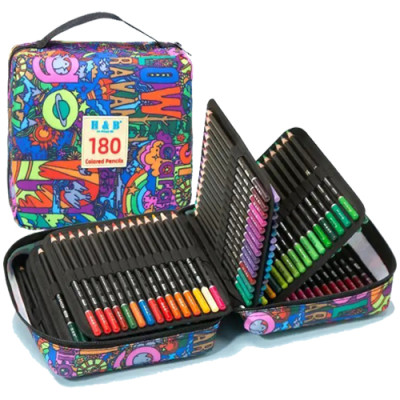
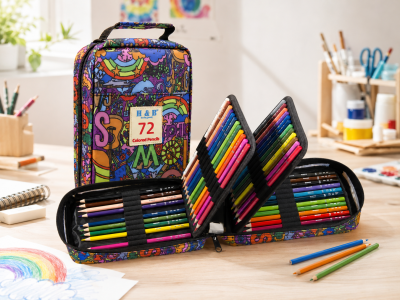
Applied to a real decision, the sequence collapses into a few rules. Selling a gift set into a market with strict child-safety enforcement means water-based ink, 12 to 24 colors and a sealed carry case. Selling into illustration channels means alcohol ink, 60 colors or more, a dual brush-and-chisel nib, and a paper recommendation included in the listing. Selling into craft and DIY channels means a water-based or acrylic paint marker with opaque coverage and a surface-compatibility chart — because in that market the question is "will it work on rock or ceramic", not "how many colors".
Matching the set to where it sells
The same factory line can serve several channels, but only if the configuration is matched to the channel. This mapping is the one buyers most often get wrong by defaulting to a single "best" spec.
| Channel | Recommended configuration | Why |
|---|---|---|
| Schools and education | Water-based, 12–24 colors, washable, bullet or fiber tip | Child-safety documentation drives the purchase; washability is a stated requirement in most tender documents |
| Children's gifting and Q4 promotion | Water-based, 24–48 colors, sealed case or tin, themed artwork | Packaging does the selling; the price point is set by the case, not the pen |
| Hobby and adult coloring | Alcohol or dual-tip water-based, 36–60 colors, dedicated marker paper bundled | Blending quality is the purchase reason, and bleed-through complaints are the main return driver |
| Professional illustration and design | Alcohol, 60–120+ colors, dual brush or chisel nib, refillable | Color range and refill availability decide brand loyalty; open-stock singles extend the range |
| E-commerce and direct-to-consumer | Dual-tip, 24–48 colors, listed with a surface chart and color-name index | Listing content, not the pen, converts; buyers screen on compatibility before price |
| Distributors and private label | Any base, color count set by the buyer's own listing, custom barrel and case | The buyer's catalog defines the SKU; the factory supplies consistency across repeat orders |

What to confirm before the first order
Most marker problems that surface after delivery were answerable at the sample stage. Before an order is placed, four things should be settled in writing:
- A locked specification sheet covering ink base, color count, nib type and size, barrel resin, cap seal and case format. If the sheet does not name the barrel resin and nib fiber, it is not a specification yet.
- Performance tests against that sheet — viscosity and flow rate, color density to a ΔE tolerance, and evaporation and leakage resistance on an aged sample, not only on a fresh one.
- A physical mockup of the retail pack, including artwork and color names, because print and color reproduction is where approvals usually stall.
- Documentary coverage matched to the destination, issued for that specific SKU rather than inherited from another product in the range.
Compliance, storage and transport
Compliance for markers splits along the same ink line as everything else. Water-based and acrylic markers intended for children follow the toy-safety route, which in practice means the EN 71 series for the EU and UK, ASTM D-4236 for US art materials, and CPSIA documentation where the product is marketed to children. Alcohol markers sit outside that route: the ink is flammable and the products are not positioned for children, which also means they are subject to flammable-liquid handling rules, need declaration for air freight, and require tighter storage conditions than water-based stock.
Two operational points are worth building into the plan. First, alcohol markers should be stored and shipped horizontally so the ink stays in contact with the nib assembly evenly — vertical storage is a common cause of uneven color on first use. Second, shelf life is solvent dependent: roughly 12 to 18 months for water-based ink where humidity is uncontrolled, and around 18 to 24 months for alcohol ink. A distributor taking a full container of a slow-moving color should know which side of that range the stock is on.
Questions buyers ask before ordering
Which marker type should a first private-label line start with?
Water-based, almost always. The raw material cost is lower, the compliance route is well established, the shipping classification is simpler, and it serves the largest buyer group. Alcohol markers are the better second line once a brand has an illustration or professional audience to sell into.
Can one factory supply both water-based and alcohol markers?
Yes, and many do — but the two lines use different barrels, nibs and cap systems, so they are separate tooling rather than one mold with a different fill. That distinction is worth confirming early, because it affects both MOQ and sampling time.
Why do alcohol markers bleed through paper?
Because the solvent carries dye into the fiber of the sheet rather than sitting on it. A marker pad around 105 gsm or heavier, described as bleedproof, is the standard answer. Selling alcohol markers without a paper recommendation is one of the most reliable ways to generate returns.
Is 168 colors too many for a wholesale set?
Not for illustration and professional channels, where range is the purchase reason. For gift and children's channels, a very high color count raises cost without raising conversion — a 24 to 48 color set in better packaging usually outperforms a 168 color set at the same price point.
What is the minimum order for a custom set?
It depends on how much of the product moves. Custom artwork on an existing case is the lightest change; a new barrel mold is the heaviest. Our standard brush and marker sets start at 300 sets per SKU, and the exact minimum for a specific configuration is confirmed against the sample.
How long does production take?
Production lead time is 15-45 days, depending on specification and packaging customizations. Stock items ship in about 3-4 days. Lead time runs from sample approval and deposit, and the approved sample becomes the production reference.
Work with H&B Art
Shanghai Haobin Cultural Supplies has manufactured art materials since 2010 and supplies importers, distributors and private-label brands in more than 60 countries. The marker range covers water-based brush pens, alcohol marker sets and water-based paint markers, with OEM, ODM and private-label capability, and factory documentation covering EN 71, ASTM D-4236, CE and BSCI. Because the ink systems are run in the same facility that assembles and packs the sets, the approved sample stays the production reference across repeat orders.
One more thing worth ordering with the markers
Bleed-through is the single most common marker complaint, and it is a paper problem rather than a pen problem. Bundling a marker paper pad with an alcohol or high-pigment set removes the returns before they happen, and it raises the average order value without changing the ink.
Start a marker specification
Send the ink base, color count, nib configuration, target market and quantity, and we will come back with a configuration, a minimum and a lead time for that specific SKU — plus a sample you can test before committing to a run.
Send Inquiry Browse Products Contact Us