How to Audit an Art Supplies OEM Factory: A Buyer’s Evidence Checklist
A factory audit should help a buyer answer a specific question: can this manufacturer repeatedly produce the agreed art supply item, document its claims and deliver the same specification on a second order? A certificate or a polished video tour can be useful evidence, but it is only one part of that answer.
Define the Product Before Auditing the Factory
Identify the end user, destination market, product type, color range, package contents and expected annual reorder pattern. A manufacturer that makes pencils may not own the process for every included brush, sharpener or tin. Ask which operations are performed in-house and which are outsourced. The audit should cover the parts that carry the main quality or compliance risk.
Give the supplier a draft specification and ask it to mark what it can meet, what it would change and what requires tooling or an external component. This reveals gaps before a quote is treated as a final promise.
Check the Factory Identity and Process Scope
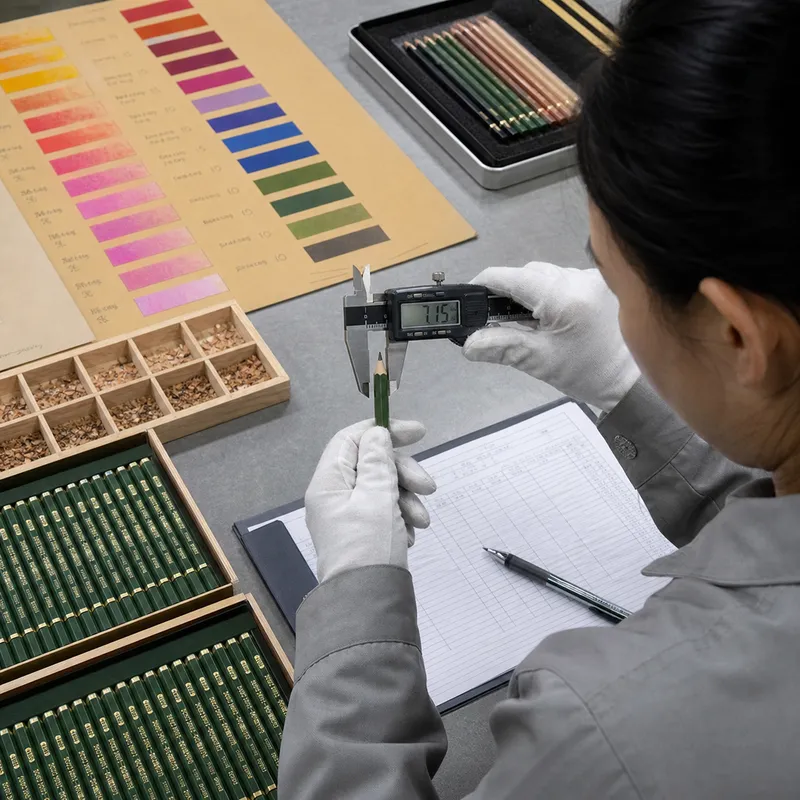
Request the legal manufacturer name and address, the factory that will make the item, a process flow and the contact responsible for quality. During a visit or live video review, compare the equipment and work areas with the proposed product. Ask to see incoming material records, work instructions, in-process checks, final inspection and handling of rejected goods.
A video tour can show equipment and workflow, but it does not prove output capacity or future availability. For a time-sensitive order, request a production plan for the stated quantity and packaging, including critical materials and outside processes. Check how a rush or repeat order would be scheduled.
Separate Quality Systems From Product Evidence
If the manufacturer claims ISO 9001 certification, request the current certificate, issuing body, address, scope and validity dates. ISO explains that external bodies certify management systems; ISO itself does not issue certificates. A management-system certificate does not certify each production batch or prove that every art supply SKU meets every destination-market rule.
For a U.S. art material, request the product-specific ASTM D4236 conformity and toxicological assessment evidence as applicable. The U.S. CPSC explains the label statement and its scope. For a product classified as a toy in the EU, request the relevant toy safety documentation and test reports for the sellable configuration. Review exact model, materials, color range, dates, versions and label artwork. Do not accept a generic “EN71 and ASTM certified” line as a document pack.
Audit the Sample Approval Path
Ask how the supplier moves from a sales sample to a production sample. Who signs off color, drawing feel, dimensions, packaging and printed claims? Which records are retained? How are deviations approved? A buyer should receive a complete packed sample and a specification with revision number, then keep a signed reference for inspection.
Test what the end user will notice. For pencils, include sharpening, point retention, laydown and barrel finish. For paints or markers, include the application surface, coverage, drying and leakage checks relevant to the product. Agree on the test conditions and sample size before setting acceptance thresholds. An isolated attractive sample cannot establish production consistency.
Ask About Traceability and Changes
Identify the batch or lot code format and whether the factory can trace a finished set to its main materials and production records. Ask how it handles a pigment substitution, packaging vendor change, altered accessory or reformulation. A change can affect color, user experience, safety evidence and label artwork. Require prior notification and sample approval for changes that matter to the agreed specification.
For a repeat order, compare the new production against the approved sample and the previous shipment. Record the outcome and any complaints. A factory that can explain how it corrected a defect often gives better decision evidence than one that promises “zero defects.”

Put These Questions in the RFQ
- Which entity and site will manufacture each main component and assemble the set?
- Which processes are in-house, and which suppliers or laboratories are involved?
- What is the realistic MOQ and lead time for this exact configuration, including artwork approval and packaging?
- Which SKU-specific reports and labels support the claims planned for the destination market?
- What is the sample-to-production approval path, inspection plan and change-notice rule?
- How will a repeat order be matched to the approved color, component and packaging specification?
Use the answers to compare whether a proposed factory can meet the order you actually intend to place. Do not publish a fixed MOQ, certification or lead-time promise until it has been checked against the current SKU and quotation.
Related Art Supply Configurations
Use these examples to start a product-specific discussion; confirm the current specification and documentation for any order.