Kids' Art Sets Wholesale: Q4 & Gift-Season Buyer's Guide
Gift season decides the year for kids' art sets. Between back-to-school clearance and the December retail floor, a narrow window carries most of the annual volume for children's drawing kits — and it closes earlier than most first-time buyers expect. This guide covers how wholesale kids' art sets are tiered, how to choose specifications by age band and sales channel, where material choices change price, compliance route and freight, and how to work backwards from a Q4 shelf date without air-freighting your margin away.
Why Q4 decides the year for kids' art sets
Art and craft materials are a growing category, not a flat one. Fortune Business Insights put the global art and craft materials market at USD 24.68 billion in 2026, rising to USD 40.71 billion by 2034 at a CAGR of 6.46% (August 2026). A separate estimate from GlobeNewswire places the art materials market at USD 9.97 billion in 2025 and USD 10.56 billion in 2026, on track for USD 14.86 billion by 2032 at 5.86% CAGR (January 2026). Whichever figure a buyer anchors to, the direction is the same: steady expansion, with children's ranges as one of the most giftable segments.
What that growth does not tell you is when the revenue lands. For children's art sets, a disproportionate share of annual sell-through concentrates in the gift quarter, and the purchasing decisions that feed it are made months earlier. Trade observations from wholesale marketplaces show children's art kits and watercolor sets commonly positioned in the gift and children's retail channel at roughly USD 6–9 wholesale (Faire wholesale buying guide, July 2026) — a price band that only works if freight and packaging were locked in before peak-season rates and space tighten.
The four product tiers buyers actually stock
Kids' art sets are not one product with different pictures on the box. They are four distinct tiers that behave differently in assortment planning, price laddering and freight. Most range plans that underperform in Q4 have a gap in the middle two tiers rather than in either extreme.
| Tier | Typical contents | Age band | Strongest channel | Assortment role |
|---|---|---|---|---|
| Entry (12–24 pieces) | Colored pencils or crayons, one pad, sharpener, sticker sheet | 3–6 | Grocery, discount, party-favor and stocking-filler programs | Traffic driver and low-risk trial SKU; smallest carton cube per unit |
| Mid (48–74 pieces) | Mixed media: colored pencils, watercolor pencils, markers, brushes, sketchbook, case | 6–9 | School programs, specialty toy retail, education distributors | Volume engine; the tier school tenders and teacher-recommended lists specify most often |
| Advanced (120–146 pieces) | Large pencil and pastel counts, drawing tools, portfolio case or easel, blending accessories | 9–12 | E-commerce, art-supply retail, gift-with-purchase upgrades | Higher ticket and higher perceived value; best gift-season step-up offer |
| Bulk classroom (200+ pieces) | High component counts across multiple media, classroom storage tray | 5–12 | Institutional supply, wholesale distribution, large-format retail | Margin-per-unit is lowest but order value and reorder predictability are highest |
The practical implication is that tier defines your compliance scope and your freight profile at the same time. Moving from entry to advanced roughly doubles carton cube per unit while adding components that each need to be assessed — so a tier upgrade is a supply-chain decision, not only a merchandising one.
Specification selection: turning age and channel into a decision
Buyers who specify by "what looks good" end up with ranges that cannot be merchandised. The reliable approach is to derive specifications from three inputs in a fixed order.
1. Age band drives component safety and core hardness
Age band is not a marketing label — it determines which components are permissible and how robust the consumables must be. For ages 3–6, the working priority is that a set survives how a four-year-old actually uses it: thicker cores that resist snapping, shorter pencil lengths that reduce leverage, rounded tips, and no small detachable pieces that create a choking-hazard assessment. For 9–12, hardness and pigment laydown matter more than durability, because the buyer is layering and blending rather than pressing hard on a drawing pad.
2. Sales channel drives piece count and packaging format
Each channel imposes a different ratio of components to packaging. Gift retail needs visual density — the count on the box is the selling proposition, so a higher component count with a clear tray or window works harder. School programs need practical density — organizers, labeled slots and refillable compartments matter more than raw count, because the set is used repeatedly in a classroom. E-commerce needs structural density — packaging that protects during parcel transit and presents well in a listing image, since there is no shelf to sell from. Wholesale distribution needs logistics density — the smallest cube per unit at the highest sell-through certainty, which usually means fewer, proven configurations rather than many variations.
3. Target price ladder drives SKU count, not the other way round
Set the retail ladder first, then work back to wholesale and landed cost, then choose how many tiers you can support. A three-step ladder (gift entry, core mid, premium advanced) is normally more profitable than a five-step ladder in this category, because each additional tier multiplies artwork, packaging tooling and testing scope. Note also that minimum order quantities in art supplies apply per SKU, not per order, so tier proliferation multiplies your MOQ commitment — H&B's standard program starts at 300 sets per SKU, which means the ladder width directly determines the cash you tie up.
Material differences that change price, compliance and freight
Two sets with the same piece count can differ in landed cost by a wide margin and fall under entirely different testing scopes. The differences sit in four places.
Core type and binder
Wax-based cores are the most economical and the most break-resistant, which is why they dominate the 3–6 tier. Oil-based cores lay down more saturated colour and blend further, and they hold up in the 6–12 tier where shading matters. Water-soluble cores add a second usage mode — dry drawing plus brush work — and carry a higher unit cost, because the binder chemistry is more demanding and the core is more sensitive to humidity in transit. The practical selection rule: match the core to the drawing activity the buyer's end customer will actually do, not to the highest specification available. A wax-based set at the right price outsells an over-specified oil set in the entry tier.
Barrel and case materials
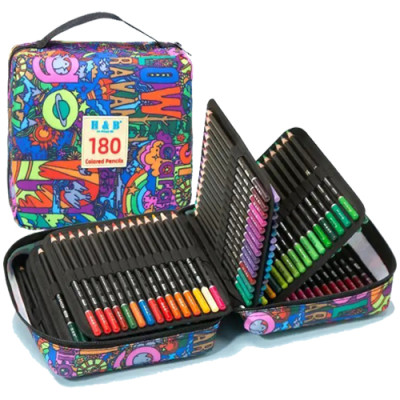
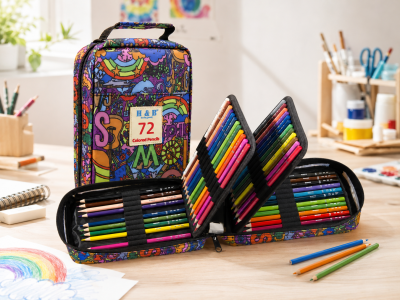
Barrels are generally wood, and in children's ranges the relevant difference is that painted or lacquered barrels must be assessed for the coating as well as the timber. Cases carry more cost variation than buyers expect: a printed tin is durable and re-usable and reads as a gift, a moulded plastic tray is cheapest and best for classroom repacking, and a zipped nylon case supports portability and travel positioning but adds soft-goods compliance and pack-out complexity. Case choice also changes carton cube meaningfully, which feeds directly into Q4 freight cost.
Pigments, coatings and non-toxicity documentation
Non-toxicity is the single largest driver of testing cost and timeline. Sets that include paint, markers or pigments fall under a broader assessment than a set containing only pencils and paper, because the formulation itself is evaluated. The buyer's practical move is to lock the compliance route before artwork is commissioned, since changing a component later can invalidate testing already paid for.
Packaging engineering
Retail-ready packaging — printed box, tray insert, hang tab or window — is a material cost, not an afterthought. In gift season it is also the difference between selling through at full price and entering January with clearance stock. Because packaging is usually the longest-lead custom element after the components themselves, it should be specified before the order, not after sampling.
Application scenarios and the configuration that fits
The same product family serves very different buyers. Mapping scenario to configuration removes most of the guesswork.
Schools and education programs
Recommendation: mid tier (48–74 pieces), mixed media with organizers, refillable compartments and no loose small parts; moulded tray case over tin; core choice weighted to durability. A representative build is our school mixed media drawing kit, which scales the same logic upward for larger classroom programs. Buying logic is reorder predictability and per-unit classroom cost, not gift presentation.
Gift and holiday retail
Recommendation: entry to advanced tiers with printed tin or window packaging; higher visible component count; a step-up pair (one entry, one advanced) so the range can carry both an impulse price point and a gift price point. Buying logic is sell-through velocity in a four-to-six week window.
E-commerce and private label
Recommendation: advanced tier with a distinctive case, brand-ready packaging and a configuration that photographs legibly in a single hero image; artwork and logo fully customised. Buying logic is perceived value per unit and protection in parcel transit.
Wholesale distribution and institutional supply
Recommendation: bulk classroom tier (200+ pieces) plus one or two proven mid-tier staples; minimal SKU count; classroom storage and repacking designed in. Buying logic is landed cost per piece and the ability to reorder the identical configuration.
Compliance: which route applies to your kids' art set
This is where most first-time importers lose time, because the question is not "is my product safe" but "which rule applies to my product".
In the United States, a children's art set can fall under two different frameworks depending on how it is classified. Section 106 of the Consumer Product Safety Improvement Act of 2008 made ASTM F963 a mandatory consumer product safety standard for children's toys, codified at 16 CFR part 1250, and toys must be tested at a third-party laboratory accepted by the CPSC. Separately, art materials carry labelling obligations under ASTM D-4236 for chronic hazard identification. If a set is classified as a toy, the toy standard drives the test plan; if it is classified as an art material, the art-material labelling route applies — and a mixed set with play components can attract both.
For the European Union, the EN 71 series applies to toys, with EN 71-3 governing the migration of certain elements — the part most relevant to pencils, pigments and printed surfaces — alongside CE marking obligations and the documentation a distributor will ask for. Age grading on the packaging must be consistent with the assessment, because a mismatch between the stated age band and the tested configuration is one of the most common reasons a shipment is held.
The buying consequence is direct: decide shelf-market and age band first, confirm the applicable standard with your supplier's testing partner before tooling, and keep the tested configuration frozen for the season. Retesting a changed component late in the Q4 window is how orders miss their vessel.
Working backwards from a Q4 shelf date
Peak-season capacity is not available on demand. Ocean freight peak season runs from August through October, with a second rush ahead of Chinese New Year, and during major peaks shippers are advised to book ocean freight six to eight weeks in advance (industry peak-season guidance, 2026). For Christmas arrival, the practical sailing cut-off is around 20–25 November for Europe and approximately 25 November for the US West Coast (Q4 peak-season shipping guide, September 2026). China's National Day Golden Week falls on 1–7 October 2026, which removes a production and documentation window from the middle of the quarter.
Those dates set the frame. From there the sequence is fixed: lock specification and compliance route, complete sampling and approval, convert to purchase order with packaging artwork finalised, produce and inspect, book freight ahead of the October capacity squeeze, then sail. Each step consumes calendar weeks, which is why buyers who finalise configurations in the first half of the year are choosing from available capacity, while buyers who finalise in August are choosing from whatever is left. The sets that reach the December floor at full margin are almost always the ones specified earliest.
Working with H&B Art
Shanghai Haobin Cultural Supplies Co., Ltd. (H&B Art) has manufactured art supplies since 2010 and exports to more than 60 countries. Production covers colored pencils, markers, watercolor and acrylic paints, pastels, paper and assembled kits, with compliance documentation for EN 71, ASTM D-4236, CE and BSCI-audited facilities. Programs are structured around OEM, ODM and private-label work — custom colour counts, branded packaging, custom cases and assortment design — with a standard minimum of 300 sets per SKU. For gift-season programs, the practical starting point is a conversation about shelf market, age band and target retail ladder before artwork is commissioned.
Frequently asked questions
What is the minimum order for children's art sets?
H&B's standard program starts at 300 sets per SKU. Because the minimum applies per SKU rather than per order, the number of colour counts or configurations in your range determines your total commitment, so widening the range raises upfront volume more than most buyers expect.
Are kids' art sets treated as toys for testing?
It depends on classification. In the United States, sets classified as children's toys fall under ASTM F963, mandatory under CPSIA Section 106 at 16 CFR part 1250, with third-party testing at a CPSC-accepted laboratory; art materials additionally carry ASTM D-4236 labelling obligations. In the EU, the EN 71 series applies, with EN 71-3 covering migration of certain elements. Confirm the applicable route with your supplier's testing partner before tooling.
When should a Q4 order be placed?
Work backwards from the retail floor date and the sailing cut-off — approximately 20–25 November for Europe and around 25 November for the US West Coast for Christmas arrival. Because peak ocean capacity runs August through October and advance booking is advised six to eight weeks out, specification and compliance decisions need to be settled well before the shipping window opens.
Building a gift-season range?
Send us your target age band, sales channel and retail price ladder. Our team will confirm the configuration, compliance route, minimum and production window for your market.
Send Inquiry Browse Products Contact Us