Wholesale Art Supplies: A Practical Buying Guide for Importers and Distributors
Wholesale art-supply buying works best when the assortment solves a clear user problem and the order can be repeated to the same specification. A distributor needs more than an attractive price list: product samples, documented claims, packaging details, lead times and a realistic landed-cost model all affect whether the set will work after it reaches customers.
Choose Products by User and Channel
Map each SKU to a real activity. A school drawing set needs clear colors, dependable sharpening, durable storage and a replacement plan. A watercolor starter set must work with the intended paper and brush. A gift kit should be easy to understand on opening and protect its contents during travel. These requirements are more useful than assuming that any category has steady demand in every market.
Use your own channel data to decide which items to stock. Review sell-through, returns, customer questions, seasonal requirements and shelf space. If that evidence is limited, start with a smaller test order and record what buyers actually use. Public market estimates do not identify the right color count or grade for your audience.
Request a Complete Product Specification
For each item, ask for the model number, materials, dimensions, color list, accessories, packaging, country-of-origin information and carton details. Define the approved sample and the revision number of the specification. If a supplier changes a pigment, barrel, case or accessory, agree when it must notify the buyer and whether retesting is needed.
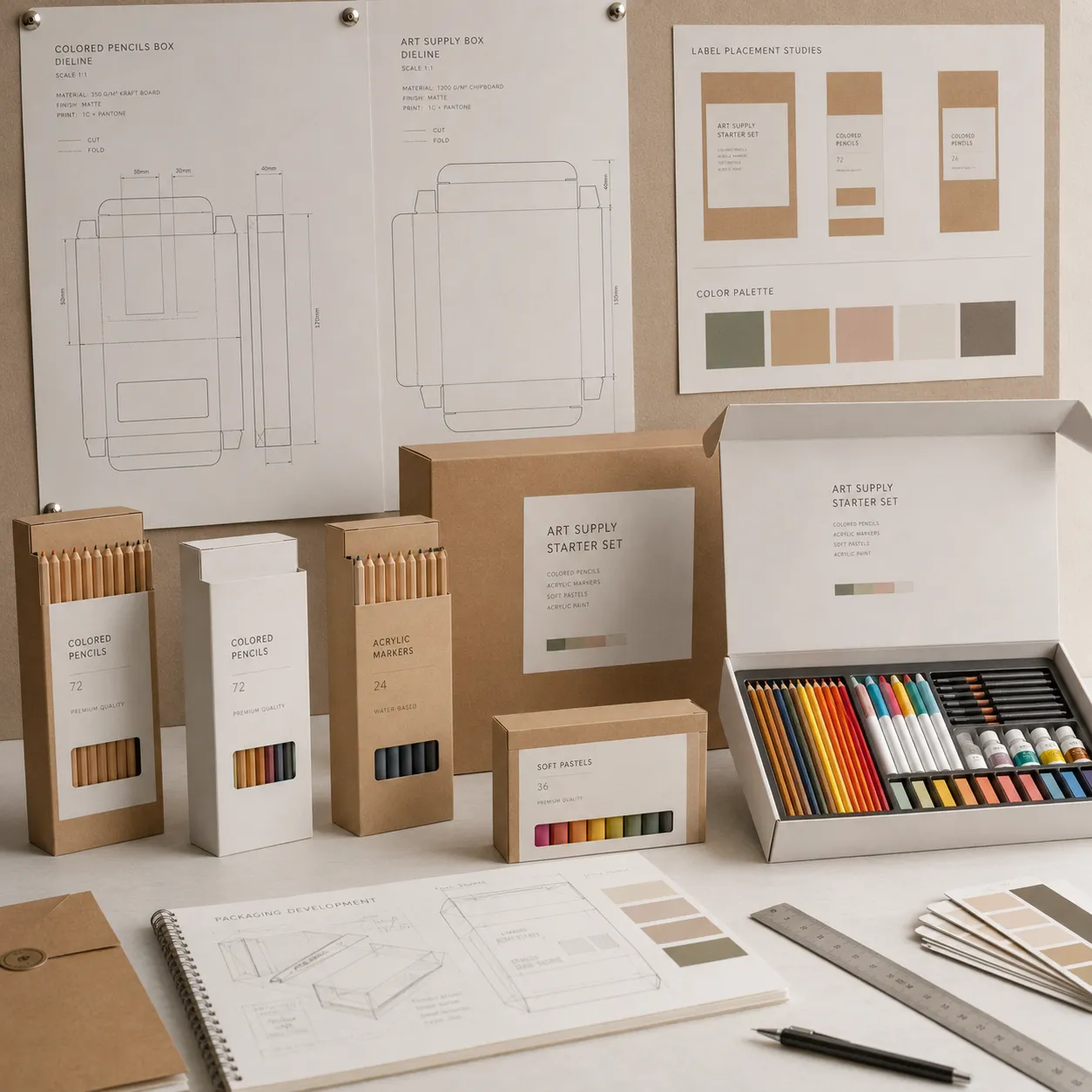
Do not rely on a catalog image to establish what is included. A “drawing kit” can contain different numbers and grades of pencils, erasers or paper. Inspect a complete packed sample and compare it to the quote, product page and proposed label. Keep a record that purchasing, quality and marketing can use together.
Sample the Set as the Customer Will Use It
Build a short task for each product line: dry drawing and sharpening for pencils; a brush-and-paper exercise for watercolors; point, cap and surface tests for markers; and normal opening, storage and transport for kits. Use the same paper, pressure, drying time or water amount across candidate samples. Record differences without claiming the exercise is a formal laboratory test.
Ask for samples from the production configuration, not only a hand-selected sales prototype. For a repeat order, compare the new shipment with the signed reference sample and agreed defect definitions. A clear sampling plan is more useful than a vague promise of “high quality.”

Keep Documents in Their Correct Categories
Different documents answer different questions. An ISO 9001 certificate, if held, concerns a manufacturer’s quality management system and its stated scope; ISO does not certify each batch. An ASTM D4236 statement concerns U.S. art-material chronic-hazard evaluation and labeling, as explained by the CPSC. An EN 71-3 report concerns migration of certain elements from toy materials. CE marking is relevant when the finished item falls under the applicable EU legislation, including toys. A social audit, if requested, addresses a different subject again.
Ask which exact SKU, components and destination each document covers, its date and version, and who issued or signed it. Do not advertise a manufacturer as universally “ASTM, EN71, CE, REACH and BSCI certified” simply because several documents appear in a folder. For claims on packaging, check the final artwork against the product-specific evidence.
Calculate Delivered Cost for the Actual Route
Compare quotes using the same specification, quantity and named trade term. The International Chamber of Commerce’s Incoterms 2020 define different allocations of cost, risk and obligations. Record the agreed rule and named place in the contract; do not compare an FOB price with a delivered price as though they were equivalent.
Add freight, insurance where applicable, customs charges, taxes, inspection, warehousing, channel fees and expected replacement costs to your own landed-cost sheet. Duty depends on classification, origin and date. For U.S. entry, check current CBP guidance; for EU entry, consult TARIC and the destination authority. Avoid a universal landed-cost multiplier.
Agree on Inspection and Replenishment
Define what will be inspected, how many units will be sampled and what counts as a defect. Include labeling, color or component count, function and packaging condition where relevant. Agree the process for nonconforming goods before production. A signed reference sample is useful only when the supplier and buyer also share the same inspection criteria.
Ask whether colors, materials, accessories and packaging can be repeated on the next order. Confirm lead time for the exact configuration and the notice required before a change. For items with high replacement demand, check whether individual pieces can be supplied. Replenishment reliability matters to the end user who expects a familiar product to perform the same way again.
RFQ Checklist for Importers and Distributors
- Who will use the product, and what task should it complete?
- What are the full SKU, component, color and packaging specifications?
- Which samples and test conditions will be used for approval?
- Which claims and destination-market documents apply to this exact item?
- What quantity, trade term, named place, carton data and production schedule are quoted?
- How will defects, substitutions and future orders be handled?
When those answers are documented, the buyer can judge value and risk without relying on broad claims about market growth, factory certificates or a low unit price in isolation.