From Approved Sample to Production: An Art Supplies OEM Checklist
A factory audit can show how a supplier works, but a buyer still needs to turn an approved sample into a repeatable production order. The risk at this stage is a gap between what sales showed, what the purchase order specifies and what the factory actually makes. A clear approval pack closes that gap.
Start With the Approved User Experience
Describe the end user’s task and the result the product must deliver. A colored pencil set may need predictable sharpening and a specific palette. A watercolor set may need rewetting behavior and paper that withstands the intended wash. A sketch kit may need erasers and sharpeners that work with its own pencils. The signed sample should prove those parts work together.
If the supplier has not yet been qualified, use the separate OEM factory audit checklist first. This article begins after a suitable factory and candidate product have been selected.

Freeze a Versioned Product Specification
Give the set a model number and revision. List core and barrel dimensions, materials, colors and codes, included accessories, packaging structure, printed inserts, carton dimensions and destination markets. Specify measurable tolerances where they matter and identify the method used to check them. Avoid words such as “premium” or “strong” as stand-alone acceptance criteria.
Make the specification, bill of materials, color chart and artwork share the same revision. A quote based on one packaging version and a purchase order based on another can cause rework. Ask the factory to acknowledge the final files and identify any part it cannot supply as written.
Sign a Packed Pre-Production Sample
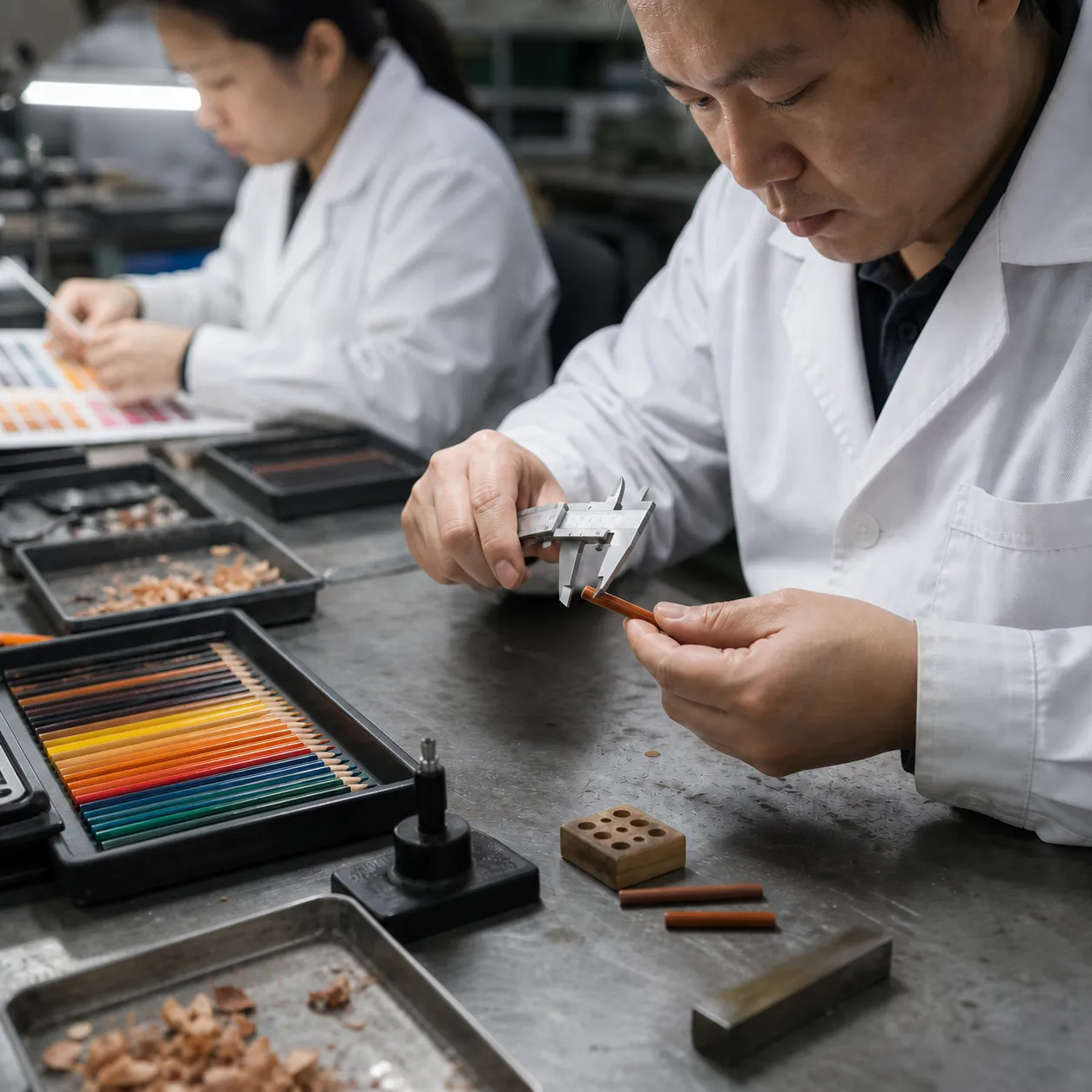
Inspect the product inside its final pack: item count, names and color codes, construction, accessories, instructions, label panels, barcode and appearance. Run the user task on samples from the proposed production materials. For color products, retain physical swatches under agreed lighting and paper conditions. Record who approved the sample and the date.
Store one reference with the buyer and one with the manufacturer if practical. For the first production lot and reorder, inspect against that reference and the written specification. A photograph is useful for records but may not capture color or tactile performance faithfully.

Define Inspection Before Production
Agree on the inspection stage, sample size and defect categories. Check missing pieces, wrong colors, broken cores, leaking containers, poor closures, misprints and damaged cartons as relevant to the SKU. Define acceptable limits and the disposition of failed goods before shipment. If a formal sampling standard is used, state its version and acceptance levels in the order rather than referring vaguely to “AQL 2.5.”
Ask whether inspections will occur during production, at final packing or both. Determine who pays for rework and how a corrected lot is rechecked. A clear plan lets the buyer act on the findings without improvising after the shipment is ready.
Match Documents to the Final Configuration
Make a document matrix by destination market. For U.S. art materials, the CPSC explains ASTM D4236 assessment and labeling. For EU items classified as toys, review applicable toy rules and product-specific evidence. A management-system certificate, product test report, toxicological review and final label each answer different questions.
Compare the documents with the final bill of materials and artwork. Adding a sharpener, changing a pigment or moving to a new package may require another review. Do not claim that one report covers every variant without checking its stated scope.
Agree on Change Control and Reorder Conditions
Identify changes that require prior written approval: color formulas, wood or barrel material, core size, accessory supplier, case construction and label copy. Require the manufacturer to state the effect on price, timing, user experience and existing documents. If a change is necessary, request a new sample and record the accepted revision.
Ask how the factory will reproduce the approved colors and components in a later order. Confirm whether a popular shade or replacement part can be supplied independently. A stable reordering process protects both customer trust and inventory planning.
Use a Purchase Order Checklist
- Exact SKU, quantity, product and packaging revision.
- Approved physical sample and color references.
- Final artwork, label languages and documented claims.
- Inspection plan, defect definitions and corrective-action process.
- Current market-specific document list and delivery dates.
- Trade term, named place, carton details and payment milestones.
- Change-notice rules and reorder conditions.
Do not use a universal first-order value or lead-time estimate to approve the project. Ask for a current schedule and quotation based on the final configuration. The purchase order should make the agreed user experience reproducible.