How to Evaluate Watercolor Paint Sets for Wholesale Orders
A wholesale watercolor set should be judged by what the user can paint with it: how the color activates, spreads, mixes, dries and behaves on the intended paper. Country of manufacture alone does not define quality. Buyers can make a better decision with a repeatable sample test, a clear set specification and product-specific documents for the destination market.
Define the Watercolor User and Technique
A beginner or school user may need colors that activate readily, a simple palette and clear instructions. A travel painter may care about compact storage, secure pans and a usable brush. A more experienced painter may need transparent washes, predictable mixing and color-specific lightfastness information. These are testable product requirements; “professional grade” is not enough detail by itself.
Ask what paper the user will have, whether the work is a quick sketch or layered painting and how the set will be stored. If a box includes a brush or notepad, test those exact components with the paint. The finished set is the product the customer experiences.
Test Activation, Washes and Drying
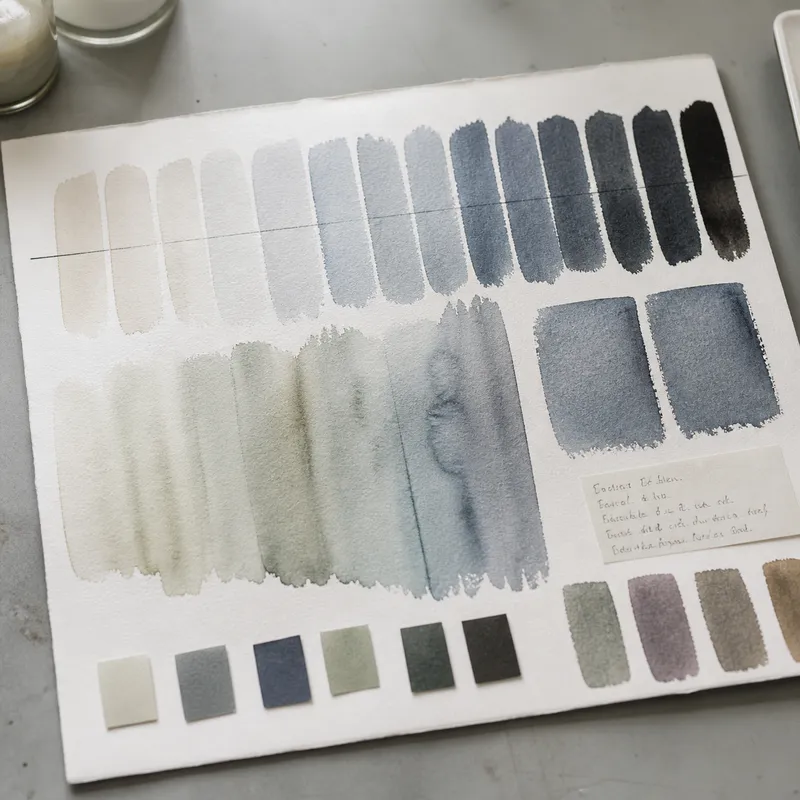
For solid pans, apply a consistent number of damp-brush strokes before making a swatch. Record how quickly the paint releases, whether the pan crumbles and whether a single stroke gives even coverage. Make a light wash and a dense area, then let both dry fully. Some colors change noticeably as they dry; a printed chart cannot replace a physical dry swatch.
Layer a second wash after the first is dry and note whether the underlying color lifts. Test two-color mixing and watch for unexpected dullness or separation. Rewet a dried swatch to understand what the user can correct later. These observations depend on formulation and paper, so compare samples under the same conditions rather than generalizing from one product line.
Include Paper in the Test
Light drawing paper may buckle or pill under a wash. Use a paper weight and surface that match the customer’s expected use, then repeat on the paper included in any proposed kit. Record buckling, surface damage, pooling and edge control. A watercolor set sold with unsuitable paper can disappoint users even when the paint itself performs well.
If the set includes a brush, assess point shape, shedding and water control. If it includes a water brush, inspect the reservoir and cap. Test the complete activity from setup to cleanup; do not rate the paint in isolation and then assume the kit works.

Compare Color Selection and Replenishment
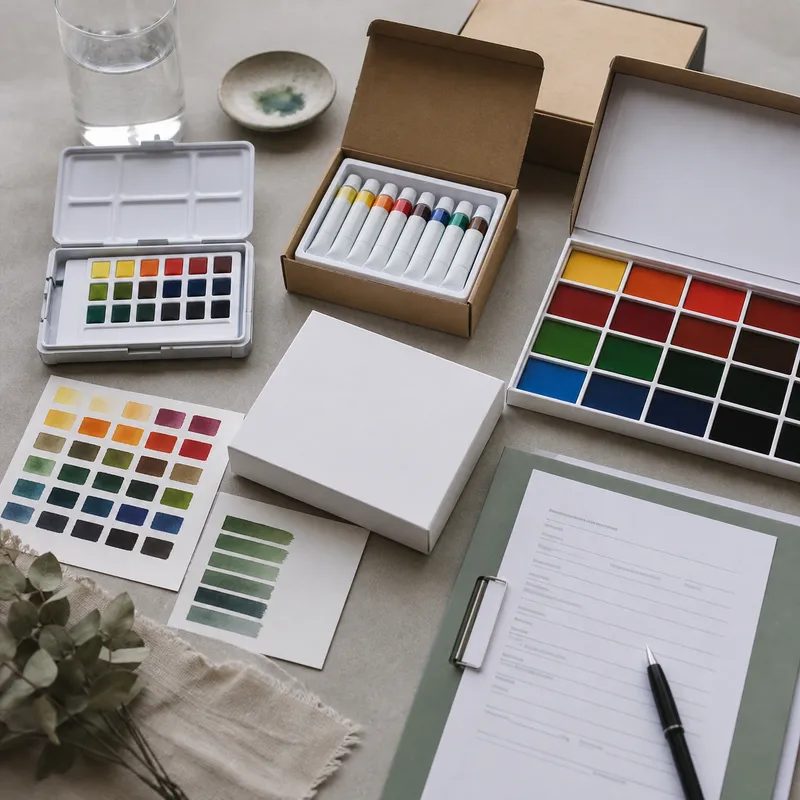
Check whether the range offers useful warm and cool options, value range and mixing partners for the target user. A large set can be less useful if many pans are nearly identical or popular colors cannot be replaced. Ask for physical swatches with color names and codes, and compare them with the labels on the pans and package.
For a repeat wholesale order, confirm whether the formulation, colors and pan sizes will remain consistent. Request notice before pigment or binder substitutions. Keep an approved sample and swatch sheet as production references.
Inspect the Container and Shipping Pack
Check pan adhesion, lid closure, mixing area and the amount of movement inside the case. After normal transport handling, open the set and look for cracked pans, loose components, leakage or damaged paper. Define what counts as a defect and how many units will be inspected. A compact tin may be useful for travel, but only if the closure and inserts protect the contents.
Ask for unit dimensions, carton pack, weight and packaging material in the purchase specification. If a brush, sponge or notepad is added, update the component list and the cost model.
Review Claims and Market Documents
For any lightfastness claim, request the method and color-specific results. For washability, test the exact surface and cleaning method promised. Avoid using “non-toxic” as a stand-alone proof of suitability. The U.S. CPSC explains the art-material assessment and ASTM D4236 label statement; it also notes that “non-toxic” is not defined by that regulation. For an EU item classified as a toy, review the applicable toy safety evidence for the complete kit.
Check that documents identify the actual SKU, colors, accessories, dates and destination-market label artwork. A report for one paint set should not be presented as blanket coverage for every set or formulation.
RFQ Checklist for Watercolor Sets
- Who is the intended user, and what painting task should the set support?
- What are the formulation, color list, pan or tube size and included accessories?
- Which paper, brush and water conditions will be used to approve samples?
- What wet, dried and rewetted swatches will be provided?
- Which claims and destination-market documents apply to this exact SKU?
- What are the carton, lead-time, change-control and reorder terms?
Use the answers to choose a set that helps the painter make the promised work and can be supplied consistently after the first order.