Working Backwards from a Fixed Delivery Date: A 2,200-Piece Branded Pencil Set Case

A fixed retail date turns a pencil order into a scheduling problem before it becomes a pricing problem.
On 20 October 2026 a buyer in Australia posted a requirement for 2,200 units of a 0.5 mm plastic mechanical pencil set, blue barrel, printed with their logo, packed as a set, and delivered in time for mid-December. Nothing in that description is unusual. What makes it a planning problem is the final clause: a fixed retail date standing behind a specification that is still open.
This case is built from that anonymized requirement and from the production windows H&B Art publishes. It is a planning case, not a shipped-order record: no buyer identity, commercial terms or shipment outcome are implied. The point is narrower and more useful — to show how a delivery date is actually derived, and where a calendar like this one breaks.
Why this order could not be quoted from a price list
An RFQ is not a specification. It is a set of constraints, and each constraint removes options before price is even discussed. Read the Australian request line by line and five separate locks appear.
| What the buyer wrote | What it actually locks | What it leaves open |
|---|---|---|
| 2,200 units | A small run, far below container scale. Line capacity is rarely the constraint at this size; colour runs, print setup and set assembly are. | Whether the quantity is a trial order or the first of several |
| 0.5 mm mechanical pencil, plastic body, blue | Which stock bodies exist in that mechanism and colour, and whether the barrel is moulded in-house or bought in as a component | Clip style, grip material, eraser configuration, refill specification |
| Customer logo printed on the barrel | Print method and printable area. Pad printing and digital print need different artwork, and a curved hexagonal or round barrel limits the print window | Logo size, colour count, exact position along the barrel |
| Set packaging | The insert, the carton, the barcode and the case pack. Packaging has its own minimum order quantity, separate from the pencil itself | Whether the set is a blister, a folding carton, a pouch or a tray in a box |
| Arrival in Australia by mid-December | The only date the buyer genuinely controls is the purchase order date. Every other date is derived backwards from the arrival target | The port of discharge, the forwarder, and whether air freight is acceptable |
Four of those five locks are specification decisions that a factory can help resolve in a day. The fifth is arithmetic, and it is the one that decides whether the order is possible at all.
The 95-day envelope behind a fixed date
H&B publishes its OEM flow as seven steps, with sampling at 7–15 days and mass production at 15–45 days depending on specification and packaging complexity. Add the buyer-side artwork approval loop and the forwarder's transit time, and the full envelope appears. The transit figure below uses 35 days for ocean freight and import clearance purely as an illustration — replace it with the number your own forwarder quotes.
| Stage | Duration used | Latest completion, counted back from arrival day D |
|---|---|---|
| Artwork approval and PO issue | 5 days (buyer side, illustrative) | D − 100 |
| Sampling and sample sign-off | 7–15 days (published) | D − 95 to D − 85 |
| Mass production, in-line QC and packing | 15–45 days (published) | D − 80 to D − 40 |
| Ocean freight and import clearance | 35 days (illustrative) | D − 35 |
| Arrival and handover | target date | D |
Two conclusions fall straight out of that table. First, the same order is a 62-day job on a stock configuration and a 100-day job on a fully custom one. A 38-day spread sits inside a single quotation, and it is driven entirely by specification choices, not by the factory's speed. Second, on the illustrated 35-day transit, a requirement posted on 20 October cannot reach a 15 December arrival even on the fastest published path. At that point the honest answer is not a price — it is a choice between a shorter transit, a later delivery point, or a stock configuration that removes the sampling round.
That is the moment most sellers get wrong. Quoting a number against a date that the calendar cannot support creates a delivery failure with a purchase order attached to it.
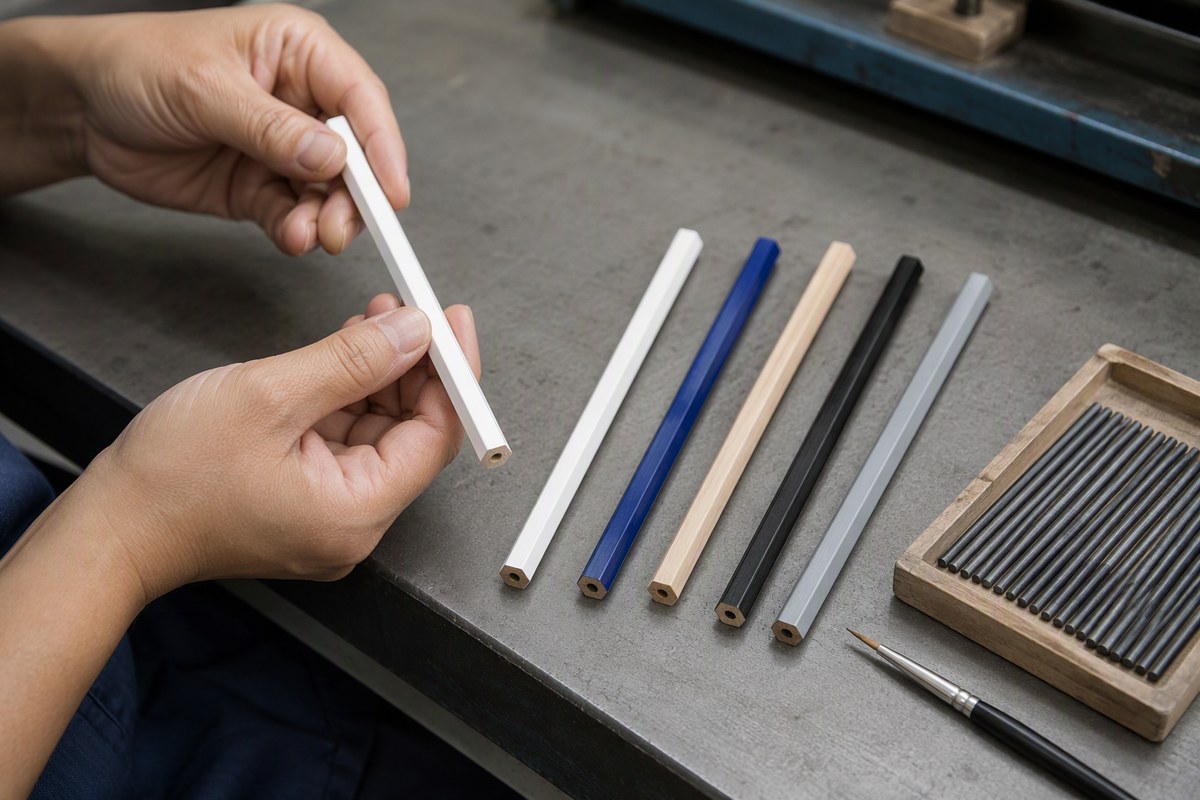
Sample approval is the stage where a fixed date is usually won or lost. Each revision restarts the clock at 7 to 15 days.
Why 2,200 pieces is the harder number, not the easier one
Small runs feel simple. In practice they concentrate cost into the steps that do not scale down:
- Print setup. Plates, screens or a digital print file cost the same at 2,200 units as at 22,000, so the per-unit share is ten times higher.
- Colour runs. A single blue barrel is friendly. Two blues, or a blue plus a white imprint, split a small quantity into runs that each carry their own setup.
- Packaging minimums. Cartons, inserts and printed sleeves have their own MOQ. This is why a quote for what looks like the same set can differ sharply: one supplier is quoting an existing structure with new artwork, the other is quoting a new die.
- Inspection. Published sampling practice runs at AQL 2.5 or stricter. On a small lot a single defect consumes a larger share of the sample, which is a quality advantage but also why small runs are inspected as carefully as large ones.
Three quote clocks, one product category
The same week produced three pencil requirements that look similar and behave nothing alike. They are worth placing side by side, because they show that "what is your lead time" is not one question.
- Japan, 3,000 / 6,000 / 120,000 units. The buyer asked for the unit price and the delivery time at each of three quantities. Quantity changes the material buying position and the line slot, so the clock changes with the tier. A serious quotation answers both columns at every tier.
- Bangladesh, 20,000 units under USD 0.01 per pencil. Here price is the entire specification. The calendar is flexible because the product is standard, and any custom element would break the target price before it broke the schedule.
- Indonesia, 1,200,000 filled pencil cases. The bottleneck is not pencil production at all. It is component supply and packing capacity, which is why this kind of order is quoted on packing lines and warehouse space rather than on extrusion speed.
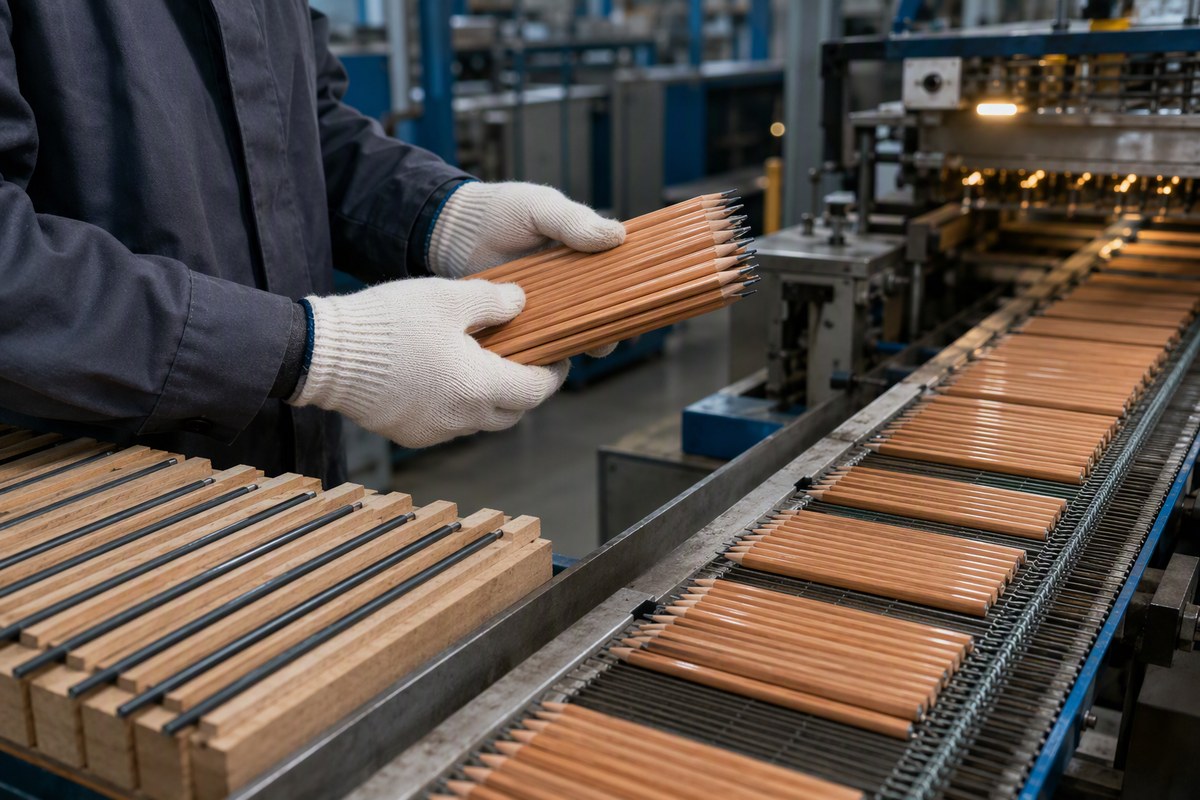
Production is the most predictable segment of the chain. The unpredictable ones sit on either side of it.
Compliance documents are a schedule item
In the same seven-day window, two US buyers requested 72-colour pencil sets — one at 50,000 units in a heavy-duty metal tin, one at 1,000 units with a canvas case — and both asked, in their first message, for documentation an Amazon seller can accept. Neither asked about price first.
That ordering is correct, because EN71 and ASTM D-4236 paperwork behaves like a production step rather than an attachment. If the request for test reports or declarations arrives after the sample is approved, it enters a queue that production cannot absorb. H&B publishes ISO 9001, ASTM D-4236 and EN71 compliance, which means the declarations exist before the order does — but the buyer still has to ask for the right document set, in the right market language, early enough for it to travel with the shipment.
Five ways a calendar like this one breaks
- Artwork arrives as a picture instead of a file. A French buyer in the same week asked for a white barrel with a blue end and a specific wordmark, reproduced 1:1 from a breakdown drawing. That is achievable, but each redraw is a full approval loop. Vector artwork and a dimensioned drawing remove two rounds before they happen.
- The packaging structure changes after the sample. Switching from a folding carton to a moulded tray, or from a printed box to a polyester case, restarts the die and the packing study.
- Logo placement is approved after print setup. Position and size decide the print method. Approving them late converts a print job into a re-print job.
- Compliance is raised at the end. Test reports, declarations and label artwork are requested after production, when nothing can be re-cut.
- Sampling and production are planned in parallel. On custom lacquer colours and custom print they cannot overlap. Treating them as concurrent is the single most common way a 62-day plan silently becomes a 100-day one.
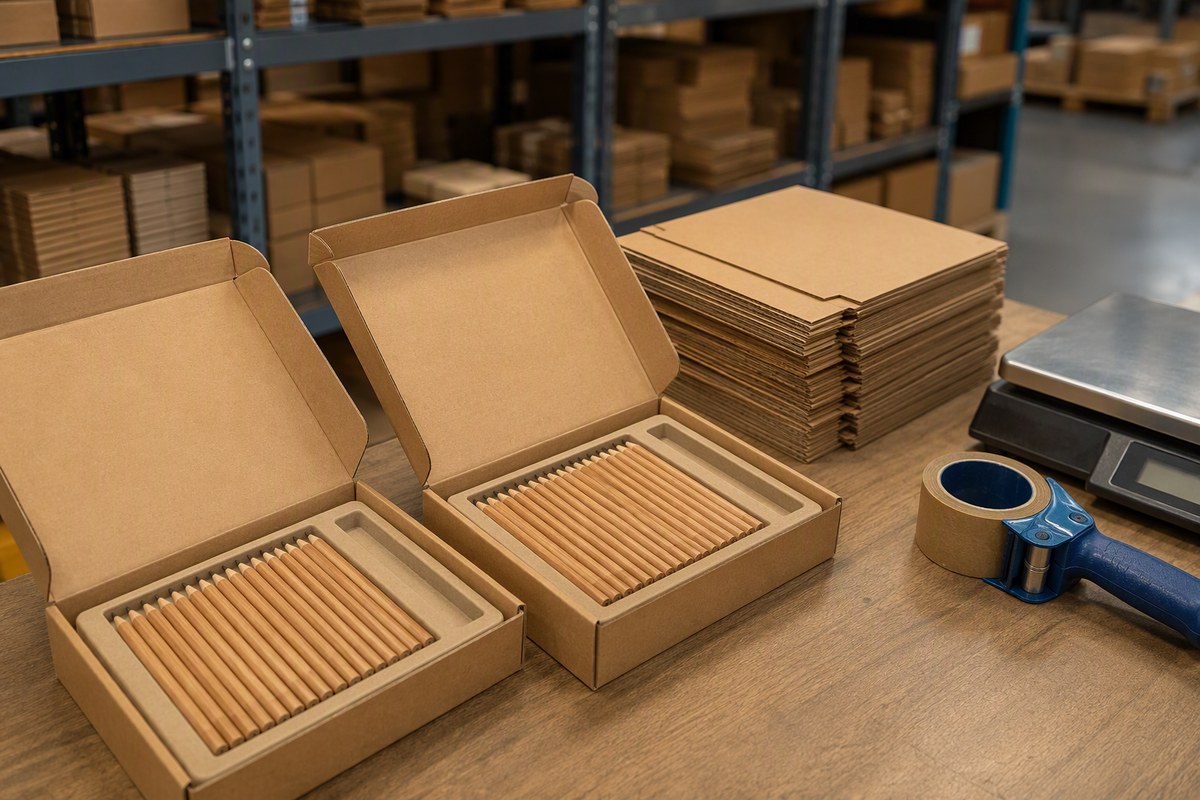
Packing sits inside the production window, and it is where late packaging changes turn into missed vessels.
What H&B publishes, and how to use it
None of the arithmetic above is proprietary. It is built from figures the site already publishes, which is exactly what a buyer should test a supplier against:
- A seven-step OEM flow from requirement sheet to shipment, with sampling at 7–15 days and mass production at 15–45 days depending on specification and packaging complexity.
- An eight-stage pencil line, from raw material weighing and kneading through grinding, core extrusion, slat grooving, shaping, finishing and packing — each stage with a measurable quality signal.
- MOQ from 300 sets, samples in about 7 days on straightforward configurations, AQL 2.5 sampling and in-line checks during production.
- Manufacturing in Shanghai since 2010, with ISO 9001, ASTM D-4236 and EN71 compliance.
Used properly, those numbers are a planning tool. Put your arrival date at the end, subtract transit, subtract the production window your specification actually needs, subtract one sampling round — and the date you get is the last honest date to place the order. If that date is already in the past, you are not buying a pencil, you are buying an exception, and the exception has a price and a risk attached to it.
A checklist to send with the RFQ
- The arrival date, the port, and whether air freight is acceptable.
- The delivery point: your warehouse, a marketplace fulfilment centre, or a retail DC. Each adds different lead time at the end.
- Barrel artwork as vector, plus a dimensioned drawing showing logo position and maximum print area.
- Whether a stock body and colour are acceptable, or the blue is a specified match.
- The packaging structure, with a dieline if one exists, and the case pack and barcode requirement.
- The target market, so the correct declaration set is chosen on day one rather than week six.
- The quantity you expect on the second order, not only the first — it changes which tier is worth quoting.
Frequently asked questions
How long does a custom pencil order take from purchase order to delivery?
On H&B's published flow, sampling runs 7–15 days and mass production 15–45 days depending on specification and packaging complexity, before freight and import clearance are added. On an illustrative 35-day transit that produces a 62–100 day envelope, which is why the specification — not the quantity — decides the date.
Can 2,200 units be produced faster than 45 days?
Yes, when the order uses an existing body, an existing colour and a standard packaging structure, because the 15-day end of the published range is reachable on straightforward specifications. Custom lacquer matching, new print plates or a new carton die move the order toward the 45-day end and add sampling rounds on top.
What actually decides whether my delivery date is achievable?
Four things, in this order: transit and clearance, the number of sampling rounds, the packaging structure, and only then the unit price. A cheaper quote that adds a sampling round usually costs more time than it saves money.
Do I need EN71 or ASTM documents before requesting a quotation?
Not to be quoted, but you should raise them in the first message. The documents exist for a compliant factory, yet requesting them late puts them in a queue behind production. State the destination market and the sales channel up front so the right declaration set is prepared alongside the sample.
Related product configurations
35 Piece Sketching Pencil Set
A drawing and shading set built on a standard configuration — the fastest path to a short sampling round.
View product33 pcs Sketching Pencils Set with Sketchbook
Set assembly with a bound insert, useful when the packaging structure rather than the pencil drives the calendar.
View product9 Piece Graphite Sketching Set
A compact kit with eraser and sharpener — a small-run configuration that keeps print setup to a single surface.
View productKeep reading
- MOQ and lead time for art supplies: what buyers must know
- Inside the art supplies manufacturing process, from pigment to product
- EN71-3 vs ASTM D-4236: export compliance guide
- Packaging and customization: tins, boxes and kit assembly
- From tin artwork to a premium 72-colour pencil set: the RAGI packaging case
Have a fixed date and an open specification?
Send the arrival date, the delivery point and the artwork. We will come back with the production window your specification actually needs, before quoting a price against a date the calendar cannot hold.
Send your requirement